

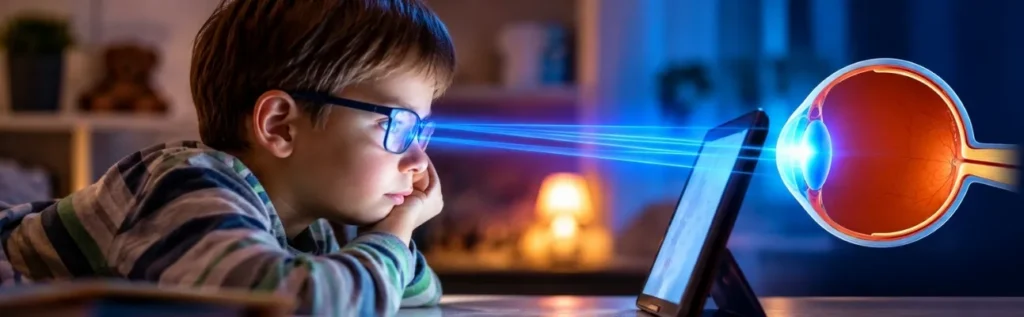
Screen Time and Kids Eyes: The Warning Signs Parents Often Miss
Screen time does not permanently damage a child’s eyes, and most children adapt well with the right habits in place. The real consideration is supporting their still-developing visual system through simple, evidence-backed practices regular breaks, sufficient outdoor time, and correct screen distance, all of which help prevent digital eye strain and keep myopia progression in check for children already predisposed to it. A routine pediatric eye exam is the most reliable way to stay ahead of any changes early, giving parents a clear, proactive way to protect their child’s vision rather than something to worry about.
By Dr. Kalpana Rose, Optometrist — Reviewed September 2026, Wallaceton Eye Care, Kitchener
What Makes Kids Eyes Work Harder During Screen Time?
A child’s accommodative and binocular vision system is still maturing well into the school-age years. Sustained near work — the kind of fixed, close-range focus screens demand — asks more of that system than it typically has to manage during natural, varied-distance activities like play.
A few developmental factors make children more susceptible than adults to the effects of extended near work:
- Accommodative flexibility is still developing, meaning the focusing muscles inside the eye tire more quickly under sustained near-focus demand than in adults.
- Blink rate drops significantly during screen use — often by more than half — reducing tear film distribution and increasing the likelihood of ocular surface dryness.
- Near work is a recognized risk factor for myopia progression, particularly in children who are already myopic or have myopic parents.
- Postural habits during screen use — leaning in, tilting the head, holding a device unusually close — often go unnoticed by parents but can indicate uncorrected refractive error or binocular vision strain.
What’s Actually Happening During Extended Screen Use?
Clinically, prolonged near work in children can produce a cluster of findings collectively described as digital eye strain, or asthenopia:
- Accommodative fatigue — the ciliary muscle, responsible for adjusting focus at near distances, becomes overworked, which can present as intermittent blur when looking up from a screen.
- Convergence strain — sustained near fixation requires the eyes to turn inward together; in children with marginal binocular control, this can bring out symptoms like double vision or eye rubbing.
- Reduced blink rate and tear film instability — leading to dryness, redness, or a gritty sensation, even in children who are not otherwise prone to dry eye.
- Transient near-point blur or headache — most often frontal or around the eyes, typically appearing after 30–60 minutes of continuous near work.
None of these findings are permanent on their own, but they are a reliable sign that the visual system is being asked to work harder than it comfortably can.
Screen Time and Myopia Progression: What the Clinical Evidence Shows
Myopia progression in children is influenced by two well-documented factors, and both are within a parent’s control to manage:
- Outdoor light exposure is the strongest protective factor against myopia onset and progression — independent of how much near work a child does. Current clinical guidance recommends roughly 90–120 minutes of outdoor time daily, making it one of the simplest, most effective habits a family can build in.
- Extended near work is linked to faster axial elongation — the physical lengthening of the eye that underlies myopia — particularly when outdoor time is limited. Balancing screen use with regular outdoor breaks helps offset this effect.
Genetics remains the primary driver of pediatric myopia, and screens are not the sole cause. But for children already on a myopic trajectory, near work and outdoor time are the two modifiable factors optometrists can actually help manage — which is exactly why early awareness and a proactive routine make a meaningful difference.
Warning Signs Parents Should Actually Watch For
Most children won’t articulate visual discomfort directly. What to look for instead:
- Sitting unusually close to screens, books, or the television
- Squinting or partially closing one eye during near tasks
- Frequent eye rubbing, especially after screen use
- Head tilting or an unusual head posture while reading or using a device
- Complaints of headaches, particularly around the forehead or eyes, after school or screen time
- Losing their place frequently while reading, or avoiding near-work tasks altogether
- Holding devices noticeably closer than an arm’s length on a consistent basis
Any of these on their own can be incidental. A pattern across several, or any that persist beyond a few weeks, is a reasonable prompt for an eye exam.
What Actually Helps: Evidence-Based Habits
The management approach here is straightforward and well supported clinically:
- Apply the 20-20-20 rule — every 20 minutes, look at something roughly 20 feet away for at least 20 seconds, to relax the accommodative system.
- Prioritize outdoor time daily, ideally 90–120 minutes, which remains the single most protective habit against myopia progression in children.
- Maintain correct screen distance and position — screens at or slightly below eye level, roughly an arm’s length away for older children.
- Encourage conscious blinking during screen use to offset the natural reduction in blink rate and reduce dryness.
- Set reasonable screen-time limits for recreational use, particularly close to bedtime, since near-focus fatigue can compound with reduced sleep.
- Ensure adequate ambient lighting during near work — screens used in dark rooms increase pupil dilation and contribute to strain.
When to See a Pediatric Optometrist
A routine, comprehensive eye exam is the most reliable way to distinguish ordinary screen fatigue from something that needs correction — an uncorrected refractive error, early myopia, or a binocular vision issue can all present with similar symptoms. It’s worth booking an exam if:
- Warning signs above are persistent or worsening
- Your child has not had an eye exam within the past year
- There is a family history of myopia
- Academic performance or reading engagement has declined without an obvious cause
- Your child has never had a comprehensive eye exam and is of school age
An annual pediatric eye exam is recommended, and sooner if any of the above apply, since undercorrected refractive error is often the underlying driver of what looks like simple screen fatigue.
Book Now
Ready to Simplify Your Glasses?
Noticing Squinting, Headaches, or Eye Rubbing After Screen Time?
A comprehensive pediatric eye exam can determine whether it’s ordinary digital eye strain or an underlying refractive issue that needs correction — and catch early myopia while it’s most manageable.
Book an eye exam →  Call us at 1 (519) 893-0100
FAQ
Frequently Asked Questions
Does screen time cause permanent damage to a child's eyes?
No. Screens do not cause structural damage to the eye. They do place sustained near-focus demand on a still-developing visual system, which can contribute to digital eye strain symptoms and, in predisposed children, faster myopia progression.
How much screen time is considered safe for children?
There is no universally fixed safe limit, since tolerance varies by age and individual visual development. The more clinically relevant factor is managing continuous near-work sessions with regular breaks, such as the 20-20-20 rule, rather than a single hard cutoff
Can too much screen time cause myopia in children?
Screen time alone is not the sole cause of myopia, which is largely genetic. However, extended near work combined with limited outdoor time is a recognized contributing factor to faster myopia progression in children already predisposed to it.
What are the first signs of digital eye strain in kids?
Common early signs include squinting, sitting closer than usual to screens, eye rubbing, headaches after near work, and losing focus during reading. These often go unreported by children and are more reliably noticed by parents or teachers.
How often should children have their eyes examined?
An annual comprehensive eye exam is generally recommended for school-age children, and sooner if symptoms of eye strain, squinting, or declining academic performance appear, or if there is a family history of myopia.
Contact us
Wallaceton Eye Care
Wallaceton Eye Care 1950 Fischer-Hallman Road, Unit 307, Kitchener, ON N2R 0V1

Mon–Fri 10am–6pm · Sat 11am–6pm · Sun Closed