
Night Driving Glasses: Do They Actually Help, or Is It a Myth?
What actually cuts glare at night is an anti-reflective coating on clear lenses ,that’s the part of “night driving glasses” that genuinely works. The yellow tint most of these glasses are known for doesn’t add any real benefit; in low light it can even dim things further by filtering out light you need. The good news is that real relief for glare, halos, or blurry night vision is usually simple: an updated prescription and the right lens coating, both of which an optometrist can check and fix directly.
By Dr. Kalpana Rose, Optometrist — Reviewed September 2026, Wallaceton Eye Care, Kitchener
Why Night Driving Feels Harder in the First Place
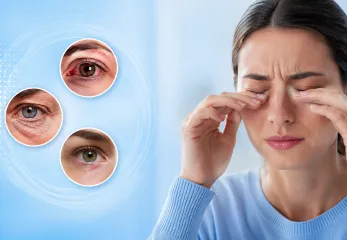
Night driving is genuinely more visually demanding, and it isn’t just in your head. A few things are working against you at once:
- Pupils dilate in low light to let in more light, which also lets in more stray, unfocused light, this is part of why headlights and streetlights look like they’re “starring” or spreading out.
- Contrast sensitivity drops after dark, making it harder to distinguish a pedestrian, a curb, or a lane line from the dark background around it.
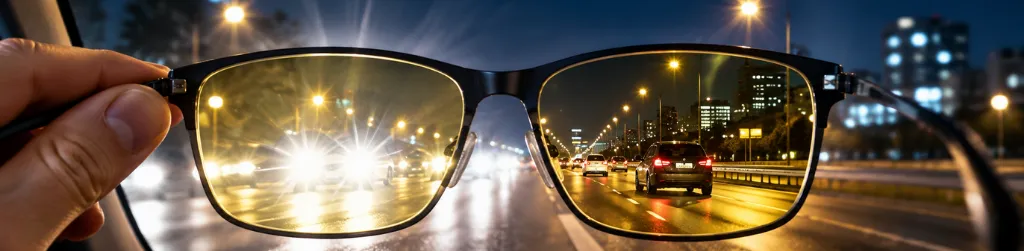
- Glare and halos around headlights and streetlights become more noticeable, especially with oncoming high beams.
- A small amount of blur Far more disruptive at night, because there’s less contrast and detail for your eyes to work with in the first place.
- Age plays a role too. Pupils naturally shrink and the eye’s lens becomes slightly less clear over the years, both of which reduce the amount of light reaching the retina after dark.
None of this is unusual, but it’s exactly the set of symptoms that “night driving glasses” claim to fix.
What “Night Driving Glasses” Actually Do
Most glasses marketed for night driving are built around a yellow-tinted lens, sometimes paired with an anti-reflective coating. The marketing claim is usually some version of “blocks glare and brightens your night vision.” The mechanism, though, is simple: a yellow tint filters out some blue light wavelengths before they reach your eye.
The problem is that filtering out any wavelength of light means less total light is reaching your eye — and at night, when light is already limited, that’s the opposite of what you want. Yellow tint doesn’t selectively remove “glare” and leave everything else untouched; it just dims the whole scene.
Do They Actually Help?
Controlled studies on yellow-tinted night driving glasses have consistently found they do not improve visual performance in low light, and in some cases modestly reduce it. Participants wearing yellow-tinted lenses at night showed no measurable improvement in glare recovery or contrast detection compared to wearing no tint at all and clear lenses with an anti-reflective coating performed better.
That last point is the key one: the anti-reflective (AR) coating is doing the real work, not the tint. AR coatings reduce the reflections that bounce around inside and across the lens surface when light hits it at an angle — which is exactly what happens when a headlight or streetlight hits your glasses at night. Strip the tint out and keep the AR coating, and you keep the benefit without the trade-off of dimming your vision.
What Actually Helps With Night Driving
If glare and reduced night vision are a real issue, these are the things with actual evidence behind them:
- An anti-reflective coating on clear lenses — cuts glare and halos from headlights without reducing the amount of light reaching your eye.
- An up-to-date prescription — even a small, unnoticed shift in your prescription tends to show up first as blur or halos at night before it’s noticeable during the day.
- Clean, scratch-free lenses — small scratches and smudges scatter light and worsen glare far more at night than in daylight.
- Addressing astigmatism specifically — uncorrected or under-corrected astigmatism is one of the most common causes of starburst and halo effects around lights at night.
- A same-day eye exam if symptoms are new or sudden — sudden glare sensitivity, especially with pain or a rapid change, is worth having checked rather than waiting.
Who Should See an Optometrist About Night Driving Trouble
A quick lens upgrade is usually enough if glare has always been a mild, manageable annoyance. But it’s worth booking an actual eye exam — not just a new pair of glasses — if any of the following sound familiar:
- Headlights and streetlights have started looking noticeably brighter, larger, or more “starburst” than they used to
- Night vision has gotten worse gradually over the past year or two
- You find yourself avoiding driving after dark
- You’re over 50, since early cataracts often show up first as increased night glare before affecting daytime vision
- Glasses or contacts feel “good enough” during the day but night driving still feels difficult
In these cases, the underlying cause is usually something an optometrist can actually diagnose and correct — a prescription adjustment, a coating change, or in some cases an early cataract — rather than something a pair of tinted glasses from an online ad can fix.
.
Book Now
Struggling With Glare or Halos on the Road at Night?
Night driving discomfort is often fixable with the right lens coating or an updated prescription — not a tinted lens off the shelf. A comprehensive eye exam can tell you exactly what’s behind it.
Book an eye exam →  Call us at 1 (519) 893-0100
FAQ
Frequently Asked Questions
Do yellow-tinted night driving glasses actually improve night vision?
No. Studies show yellow tints don’t improve contrast or glare recovery at night, and because they filter out some of the already-limited available light, they can slightly dim your overall night vision rather than improve it
What actually reduces glare while driving at night?
An anti-reflective (AR) coating on clear lenses is the main thing with real evidence behind it. It reduces the reflections and scatter that cause halos around headlights and streetlights, without dimming the light reaching your eyes.
Why do I see halos around lights at night?
Halos are most often caused by uncorrected or under-corrected astigmatism, an outdated prescription, or lenses without an anti-reflective coating. In some cases, especially in people over 50, they can be an early sign of cataracts.
Are polarized sunglasses the same as night driving glasses?
No. Polarized lenses reduce glare from reflective surfaces like wet roads and hoods in daylight, but they’re too dark for nighttime use and are not designed or recommended for driving after dark
Should I get an eye exam if night driving has become harder?
Yes, especially if it’s a new or worsening symptom. Night glare is often one of the first noticeable signs of a prescription change or an early eye health issue, and it’s easier to address the sooner it’s caught.
Contact us
Wallaceton Eye Care
Wallaceton Eye Care 1950 Fischer-Hallman Road, Unit 307, Kitchener, ON N2R 0V1

Mon–Fri 10am–6pm · Sat 11am–6pm · Sun Closed