

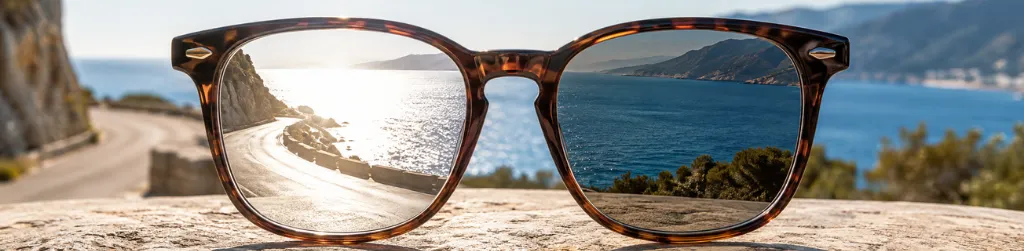
How Progressive Lenses Work: One Pair, Every Distance
The natural lens inside the eye changes shape to focus on objects at different distances, a process called accommodation. In childhood and early adulthood, that lens is flexible enough to shift focus between near and far object quickly Starting in the early-to-mid 40s, the lens gradually becomes less flexible this age-related change is called presbyopia — and it makes it increasingly difficult to focus on nearby objects
By Dr. Kalpana Rose, Optometrist — Reviewed August 2026 Wallaceton Eye Care, Kitchener
Why Your Eyes Change with Age?
This is why reading glasses alone may eventually stop being enough for most people who also need correction for distance vision. A single-vision lens can provide clear vision at one primary distance, while progressive lenses are designed to provide correction for distance, intermediate, and near vision within one lens.
The Part Patients Are Rarely Told: It’s a Gradient, Not Sections
Bifocals divide a lens into two distinct zones, usually with distance vision at the top and near vision at the bottom, separated by a visible line between them Progressive lenses work differently. Instead of having a visible dividing line, the prescription gradually changes from the top of the lens to the bottom: Distance vision the upper portion of the lens, Intermediate vision the middle portion, useful for computers and dashboards, and Near vision the lower portion, used for reading and other close-up tasks.
Because the transition is gradual, there is no visible line between the different viewing distances. This is one of the main cosmetic advantages of progressive lenses.But it also means the usable width of each zone is narrower than in a bifocal, especially at the sides. That’s the trade-off nobody explains upfront: progressives look better and function more naturally once adjusted to, but the first week or two often involves head movement replacing eye movement, since looking through the edges of the lens gives a blurred, swimming effect and why accurate measurements and proper frame fitting matter.
What the Adjustment Period Actually Feels Like
One patient described the first few days like this: “Stairs were the strange part — I kept looking down through the wrong part of the lens and everything blurred for a second.This type of experience can happen while the brain learns where different parts of the lens provide the clearest vision.
A few things that make the adjustment smoother and easier:
- Turn the head toward what you’re looking at rather than just shifting the eyes, especially for reading and stairs
- Give it one to two weeks of consistent wear — switching back to old glasses during the adjustment period slows the process down
- Expect some mild distortion in your peripheral vision at first; this is normal lens geometry, not a fitting error
- Get frames properly fitted and adjusted, since progressive lenses are more sensitive to frame position on the face than single-vision lenses
Who Progressive Lenses Work Best For
- Adults over 40 noticing blur at both near and far distances — the most common and straightforward case for progressives
- People who dislike the visible line of bifocals — progressives correct the same ranges with a cosmetically seamless lens
- Anyone frequently switching between screens, reading, and driving — the intermediate zone is particularly useful for computer distance
- First-time presbyopia patients — progressives can often be introduced early, before needing a stronger add power
- Those who’ve struggled with bifocal adjustment — a well-fitted progressive sometimes feels more natural once the initial learning period passes
When It’s Worth Talking to an Eye Doctor
Not every case of blurred near vision needs progressives, and not every patient adjusts to them equally well. Frame shape, lens design, and how the eyes track through the different zones all affect comfort — which is why a proper fitting and a short trial conversation at the exam matter more than the brand name on the lens. If a first pair of progressives never feels comfortable after several weeks, that’s also worth bringing back to the exam rather than assuming it’s just something to get used to
Book Now
Ready to Simplify Your Glasses?
If you’re switching between multiple pairs of glasses throughout the day, a progressive lens fitting can show you whether one pair could genuinely cover it all.
Book an eye exam →  Call us at 1 (519) 893-0100
FAQ
Frequently Asked Questions
How long does it take to adjust to progressive lenses?
Most people adjust within one to two weeks of consistent wear. Occasional mild dizziness or peripheral blur in the first few days is normal and typically resolves on its own.
Can progressive lenses be used for driving?
Yes, and many patients find them especially useful for driving, since the lens covers distance vision for the road and intermediate vision for the dashboard in one pair
Are progressive lenses more expensive than bifocals?
Generally yes, due to the more complex lens design and precision fitting required, though the cost difference varies by lens brand and prescription complexity
Do progressive lenses work for every prescription?
Most prescriptions are suitable for progressives, though very high or unusual prescriptions may need a specific lens design discussed at the exam.
What if I can't adjust to progressive lenses after several weeks?
This is uncommon but does happen. It’s worth returning for a refitting, since frame position, lens design, or measurement accuracy can all affect comfort and may need adjustment.
Contact us
Wallaceton Eye Care
Wallaceton Eye Care 1950 Fischer-Hallman Road, Unit 307, Kitchener, ON N2R 0V1

Mon–Fri 10am–6pm · Sat 11am–6pm · Sun Closed